Skip to content
Sights of Eger – Complete Guide to the City's Best Places
~6 min read

Sights of Eger – Complete Guide to the City's Best Places

From Eger Castle to Szépasszony Valley, from the foot of the Minaret to the Lyceum observatory – we've gathered Eger's best sights so you don't miss a thing.

Eger látnivalókegri várEgri BazilikaSzépasszony-völgyEger turizmusmit nézzünk Egerben

Eger – where history is alive, not just on display

Eger is one of the richest historical cities in northern Hungary. The reason to visit isn't some newly opened themed attraction — it's that the city itself is the experience: the castle, the baroque square, the wine cellars, the minaret, the thermal baths. All within a few square kilometres.

Below are the city's main sights in the order that makes most sense for a single day or a weekend visit.


1. Eger Castle – site of the 1552 siege

If you're visiting Eger, the Castle is your first stop. Not just because it rises above the old town and gives a view across the whole city — but because the castle is the setting for one of the most famous episodes in Hungarian history: the siege of 1552.

István Dobó and roughly two thousand defenders held off an Ottoman army of around forty thousand for nearly six weeks. When the Turks finally withdrew, the event became the cornerstone of the city's identity — and it still is today.

What you'll see inside:

  • Dobó István Castle Museum – the permanent exhibition housed in the castle buildings, covering the medieval fortress history, the 1552 siege and the archaeological finds
  • Catacombs – a network of tunnels beneath the castle carved into tuff rock, where ammunition and food were once stored; part of the system can be walked through
  • Bastions and walls – a walk along the ramparts gives panoramic views over the city, towards the Bükk hills and down into the valley
  • Medieval well – standing in the inner courtyard, with several centuries of history behind it

Practical info: The castle is open year-round except Mondays; tickets are required for the museum and catacombs. Check current opening hours and prices on the Eger Castle website. Walking up from the town centre takes about 10 minutes.


2. Eger Basilica – one of Hungary's largest churches

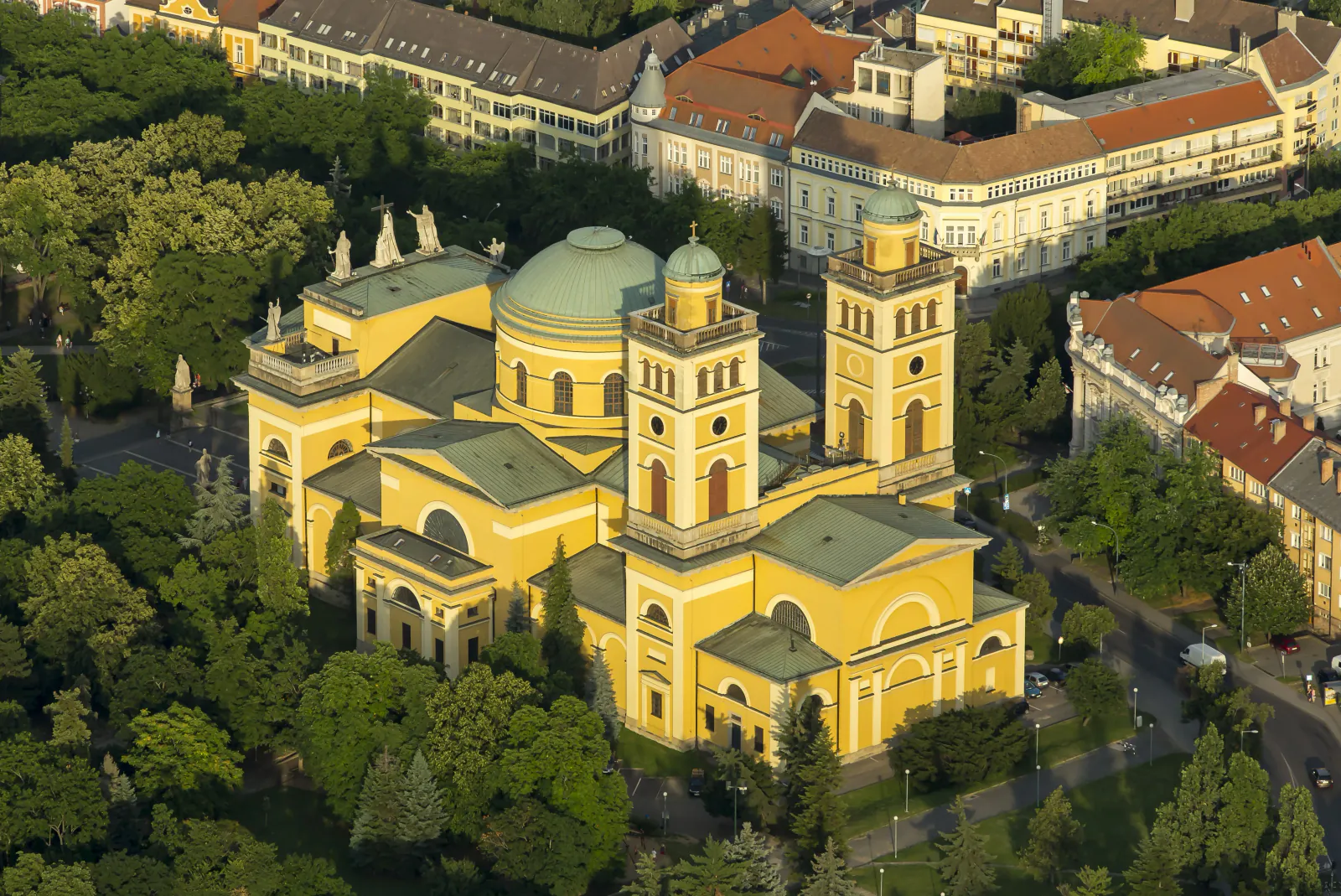
Heading up Széchenyi Street from Dobó Square, opposite the Archbishop's Palace, stands the Eger Basilica — the second largest church in Hungary, after the one in Esztergom. The neoclassical building was constructed between 1831 and 1837 to designs by Johann Hild.

Worth seeing:

  • The enormous portico on the main façade and the relief sculptures on the tympanum are impressive even from outside
  • The interior — its scale and symmetry; the nave stretches over a hundred metres
  • The organ — once among the largest in Central Europe; organ concerts are held here in summer
  • The crypts and side chapels — each worth a look on their own

Entry to the basilica is generally free. The biggest crowds arrive in summer during the late morning and early afternoon.


3. The Minaret – Hungary's only standing Turkish minaret

The Eger Minaret is the northernmost point in Central Europe and the only fully intact Turkish minaret remaining in Hungary. The roughly 40-metre tower was built during the Ottoman occupation in the first half of the 17th century.

What you should know:

  • Climbing the 97 spiral steps leads you to an upper gallery with an unmatched view over the old town
  • The staircase is narrow and steep — those with claustrophobia or a fear of heights may prefer to admire it from outside
  • The original mosque that the minaret was part of no longer stands; a small chapel now sits at its base
  • Tickets required; in season queues often form at the entrance — aim to arrive in the morning

The Minaret is reached from Kossuth Lajos Street, a few minutes' walk from Dobó Square.


4. The Lyceum and Observatory – baroque building and camera obscura

The Lyceum (now Eszterházy Károly Catholic University) is a baroque college building, commissioned in 1770 by Bishop Károly Eszterházy of Eger. Architecturally it's impressive in its own right — but the real highlight is the observatory on the roof and the camera obscura.

The camera obscura projects a live image of the city — via a rotating mirror system mounted on the roof — onto a round table in a darkened room. It's one of the rarest such devices in Europe and one of the most distinctive experiences you can have in Eger.

The route to the observatory goes through the Lyceum's interior staircase; tickets are required, and groups go up at set times.


5. Dobó Square and the baroque old town

István Dobó Square is the heart of Eger: the bronze statue standing here commemorates the hero of the 1552 siege, and along the square's edges you'll find the baroque façade of the Minorite church and many of the city's most characterful buildings.

Old town spots worth walking to:

  • Széchenyi Street – the main pedestrian street with cafés, shops and summer terraces
  • Kossuth Lajos Street – heading towards the Archbishop's Palace and the Minaret
  • Archbishop's Palace – the seat of the Archdiocese of Eger, next to the basilica
  • Cobbled alleyways around Dobó Square – particularly good for photography

The old town is easily walkable; all the main sights are within an hour to an hour and a half on foot.


6. Szépasszony Valley – the essential wine-tasting destination

Szépasszony Valley (Valley of the Beautiful Woman) opens up on the western side of Eger, a few minutes' walk from the centre. The road leading into the valley is lined with cellars — around 30 to 40 wine cellars receive visitors during the season.

What you should know:

  • Egri Bikavér (Bull's Blood) is the wine most closely associated with this place: a full-bodied red made traditionally from a blend of Kékfrankos (Blaufränkisch), Cabernet Sauvignon, Merlot and other varieties
  • Egri Leányka and Debrői Hárslevelű are the best-known local white wines
  • The valley can fill an entire day: tastings, cold platters, the cool atmosphere of the cellars and outdoor tables in summer
  • Some cellars open at 10am and receive guests until 8–10pm; shorter hours in winter

7. Thermal baths – Eger and Egerszalók

The region is well supplied with thermal bathing facilities.

Eger Thermal Spa – close to the city centre, with indoor and outdoor pools and therapeutic treatments.

Egerszalók Spa and Salt Hill – about 15km from Eger, but with one of the most spectacular natural phenomena in the area: mineral-rich hot springs have deposited limestone over centuries to create white terraced mounds on the hillside, often compared to a miniature Pamukkale. Indoor and outdoor pools are attached to the spa.


How to organise your visit to Eger

For one day: Castle in the morning → Basilica and Dobó Square in early afternoon → Lyceum camera obscura → Szépasszony Valley in the evening

For two days: Day one: Castle + old town + Lyceum + dinner Day two: Thermal bath + Szépasszony Valley + journey home (or swap the order)

Staying in central Eger makes all of this comfortable without a car. Harmónia Apartmanház puts every main attraction within walking distance.

👉 Enquire about accommodation in Eger 👉 Harmónia Restaurant

Stay in Eger

If you are planning this activity, explore our apartments, availability, and direct contact options.